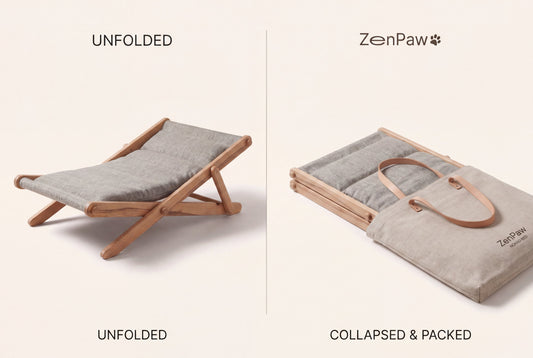

Solid Wood Elevated Pet Bed | Dovetail Joinery Hemp Linen | ZenPaw Floating Zen
Dovetail Joints, Hemp Linen, and Why Your Pet's Bed Should Be Built Like Furniture
The planned obsolescence of pet beds
Most pet beds are not designed to last. The economics of the pet industry push toward products with 12–18 month lifespans: cheap polyester fill that flattens, nylon covers that pill and collect hair, plastic or metal frames that bend or rust. The manufacturer benefits from repeat purchases. The pet's experience degrades gradually, but so gradually that the owner rarely notices until the bed has completely collapsed.
The Floating Zen was built on a different assumption: that a pet bed should be built like furniture. That the frame should be solid hardwood with hand-cut joinery. That the cushion should be natural fiber that improves with washing rather than degrading. That the piece should outlast the pet, if it's properly cared for.
What dovetail joints are and why they matter here
Dovetail joints are the interlocking fan-shaped cuts visible at the corners of the Floating Zen frame. They're one of the oldest woodworking joints in existence — used in furniture, cabinetry, and wooden structures for over 4,000 years, with examples found in ancient Egyptian artifacts and Chinese bronze-age tombs.
The reason they've persisted for four millennia is mechanical: dovetails resist pulling forces — the forces that pull a joint apart — better than any screw, nail, or pin. The geometry of the joint means that the more it's stressed in the direction that would pull it apart, the tighter it locks. A corner held by a dovetail joint gets stronger with use. A corner held by a screw loosens.
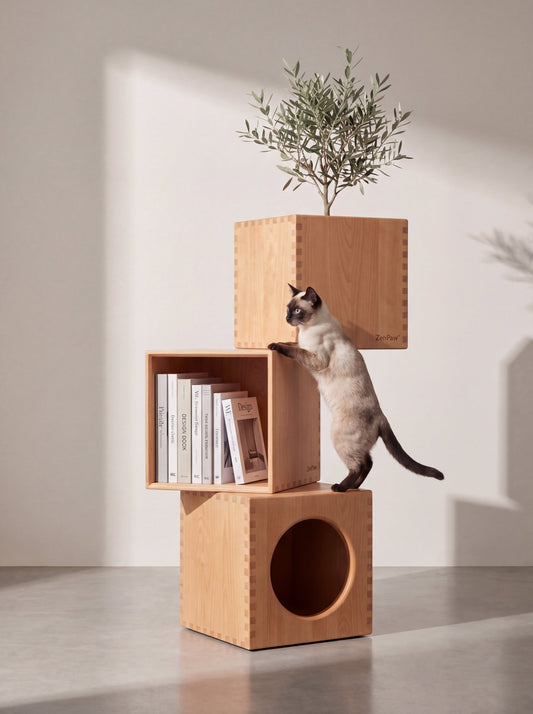
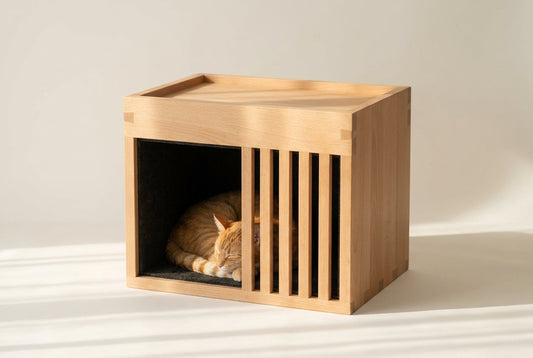
On the Floating Zen, the dovetails are visible from the side of the bed. This is a deliberate design choice. In traditional furniture-making, visible dovetails are a mark of hand craftsmanship — they're harder to cut cleanly by hand than by machine, and a tight hand-cut dovetail is a demonstration of skill. The Floating Zen doesn't hide its joinery. It shows it.
The angled legs: where the name comes from
The Floating Zen's four legs are cut at a precise outward angle — the geometry that lifts the frame off the floor and creates the visual effect the bed is named for. The angle does several things simultaneously: it widens the footprint of the base, which improves stability; it creates the floating appearance that distinguishes the piece from flat-frame alternatives; and it keeps the sleeping surface elevated above cold floors, allowing air to circulate beneath the cushion.
The legs are mortise-and-tenon jointed into the frame rails — the same ancient structural technique used in timber-frame buildings. They don't flex or rack under a large dog's weight. The angle that makes the piece beautiful also makes it structurally sound.
Hemp and linen: why the cushion material matters
Synthetic microfiber is the default for pet bed cushions because it's cheap and easy to manufacture. It also traps heat, pills after a few washes, develops a synthetic smell over time, and loses its loft faster than natural fibers. Your pet sleeps on it for hours at a time, breathing the air directly above it.
Hemp-linen is different. It's naturally breathable — the woven structure allows air movement that keeps the sleeping surface cooler. It's naturally odor-resistant. And unlike synthetic materials that degrade with washing, hemp-linen gets softer with each wash — the fibers relax and settle over time rather than breaking down. The cover zips off and machine-washes cold. The insert is replaceable. The frame outlasts both.
Sizing for cats and dogs: how to choose
The Floating Zen comes in three sizes. Measure your pet nose to tail when they're lying stretched out, then add 6–8 inches for the ideal bed length. Size S (24"L) fits cats and dogs up to 15 lbs. Size M (34"L) fits dogs 15–40 lbs. Size L (44"L) fits dogs 40–80 lbs. When in doubt, size up — a slightly larger bed is always preferable to one where the pet feels cramped.
→ Shop the Floating Zen
Tags:
Previous
Wooden Cat House Round Entrance | Sculptural Pet Furniture | ZenPaw Cove
Next
They Were Part of the House. They Should Stay Part of It. Pet Memorial Furniture | Wooden Cat House with Portrait Slot | ZenPaw