
The Complete Guide to Choosing a Wooden Cat House End Table (2026)
The Complete Guide to Choosing a Wooden Cat House End Table (2026)
Looking for cat furniture that actually fits your home? This guide covers everything cat owners need to know before buying a wooden cat house end table — from materials and joinery to sizing and safety.
If you've ever tried to make your living room look like a real home while also sharing it with a cat, you already know the struggle: most cat furniture looks like it belongs in a pet store, not a carefully decorated space. Cat trees wrapped in beige carpet. Plastic crates that clash with your sofa. Foam beds shoved under the coffee table

.
A wooden cat house end table solves this problem entirely. It's a piece of furniture first — one that happens to give your cat a private, enclosed sanctuary right at your side. No compromise on aesthetics. No wasted floor space. No guilt about the corner of the room you've sacrificed to your pet.
But not all wooden cat house end tables are built the same. This guide walks you through exactly what to look for — and why the details matter more than you might expect.
Why a Cat House End Table Is the Smartest Furniture Choice for Cat Owners
The traditional pet furniture market treats cats as an afterthought to interior design. You buy furniture for your home, then you buy separate furniture for your cat, and the two worlds awkwardly coexist.
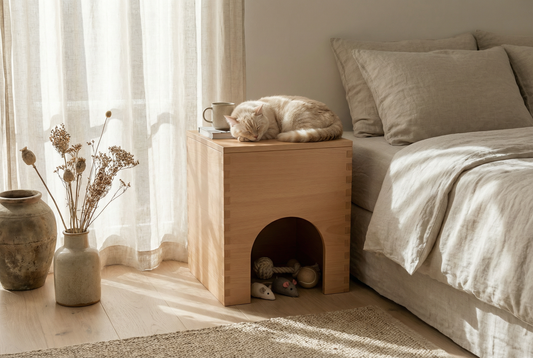
A cat house end table flips that logic. Instead of carving out a corner for a cat bed, you're adding a functional piece of furniture — a side table — that also serves as your cat's personal retreat. It holds your lamp, your book, your morning coffee. And below the tabletop, your cat has a ventilated, enclosed, cozy space that feels safe and den-like. In effect, it's an elevated cat bed built seamlessly into a piece of real furniture — no extra footprint, no aesthetic compromise.
For cats, this matters. Cats are instinctively drawn to enclosed spaces because they mimic the dens their wild ancestors used for safety and rest. A cat house end table placed next to your sofa gives your cat proximity to you without forcing them onto the couch — which is especially valuable for cats that are affectionate but also need their own space.
For you, it means one fewer piece of furniture cluttering the room, and a home that looks intentional rather than pet-overrun.
What to Look for in a Solid Wood Cat House End Table
1. Wood Species: Solid vs. Engineered
This is the most important material decision. Most cat house end tables on the market — even those marketed as "wood" — are made from MDF (medium-density fiberboard) or particleboard with a wood veneer. These materials are cheaper, but they come with real drawbacks:
- Off-gassing: MDF and particleboard are bonded with urea-formaldehyde resins, which release VOCs (volatile organic compounds) for months after manufacturing. Cats spend hours inside enclosed furniture, making this a genuine health concern.
- Durability: MDF swells and crumbles when exposed to moisture — including the natural humidity inside an enclosed cat space.
- Repairability: A scratch or dent in solid wood can be sanded and refinished. MDF cannot.
What to look for: Furniture labeled Solid Beechwood, Solid Oak, or Solid Walnut — not "wood composite," "engineered wood," or "MDF with wood finish." Beechwood is particularly well-suited for cat furniture: it's dense, smooth-grained, resistant to scratching, and takes natural finishes beautifully.
2. Joinery: How the Furniture Is Actually Held Together
Most wooden furniture — including most "solid wood" cat houses — is assembled with metal screws, wood glue, or cam locks. These are fast and cheap to manufacture, but they have a critical weakness: they loosen over time, especially in furniture that experiences the constant low-level vibration of a cat jumping in and out.
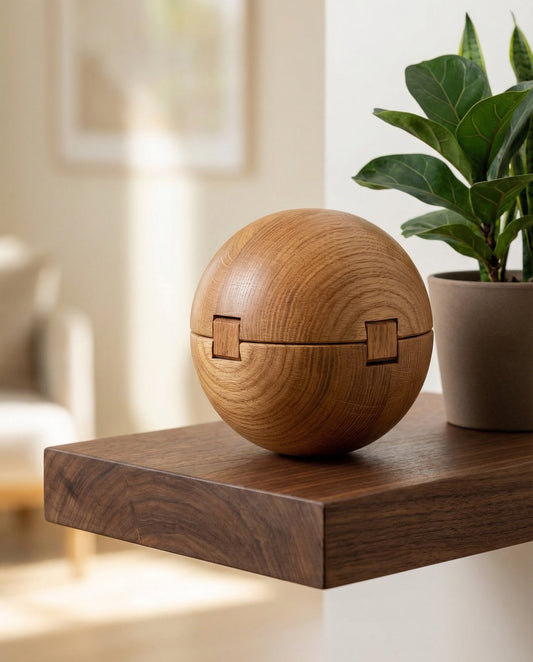
The alternative is mortise and tenon joinery — a traditional woodworking technique where a projecting tenon on one piece fits precisely into a mortise (cavity) cut into another. No glue. No nails. No metal hardware. The joint is held by the precision of the fit itself, and it actually gets tighter as the wood settles.
Mortise and tenon joinery is:
- Stronger under repeated stress than screwed or glued joints
- Repairable — individual joints can be tightened or replaced without disassembling the whole piece
- Chemical-free — no adhesives means no off-gassing inside your cat's enclosed space
- Long-lasting — traditional mortise and tenon furniture routinely lasts generations
When evaluating a wooden cat house end table, ask directly: how are the joints constructed? If the answer involves screws, cam locks, or wood glue, that's a different product category entirely.
3. Surface Finish: What Your Cat Breathes All Day
The finish applied to wood furniture is often overlooked, but it's critical for enclosed cat furniture. Polyurethane and lacquer finishes seal the wood effectively but continue to off-gas for months and can be toxic if ingested during grooming.
What to look for: A natural wood wax oil finish — a blend of plant-based oils and waxes that penetrates the wood grain rather than forming a surface film. Wood wax oil is:
- Non-toxic once cured
- Breathable (the wood can still regulate humidity naturally)
- Renewable — you can reapply it yourself at home when it wears
- Beautiful — it enhances the natural grain rather than creating a plastic-looking sheen
4. Interior Lining: The Surface Your Cat Actually Touches
The cushion or lining inside the cat house is what your cat sleeps on every day. Synthetic materials — polyester fill, foam, synthetic fleece — can trap heat, accumulate static, and are not biodegradable.
A natural hemp and linen blend cushion offers a meaningfully different experience: it's breathable, naturally antimicrobial, and comfortable without the chemical treatment that synthetic fabrics typically require. Hemp in particular is one of the most sustainable textile crops — it requires no pesticides and minimal water.
Mortise and Tenon Joinery: Why It Matters More Than You Think
Mortise and tenon is one of the oldest woodworking joints in human history — evidence of it has been found in ancient Egyptian furniture dating back over 5,000 years. It survived not because it's traditional, but because it works.
In the context of a cat house end table, the joint matters for a specific reason: cats are not gentle with furniture. A cat jumping onto the top surface of an end table, then dropping down into the interior, then jumping back out — multiple times a day, for years — creates a pattern of repeated impact stress that loosens screwed or glued joints surprisingly quickly.
Mortise and tenon joints distribute this stress across a larger surface area. The joint doesn't rely on a single point of contact (a screw thread, a glue line) — it relies on the entire mating surface of tenon against mortise. The result is furniture that handles daily cat use the way it was designed to: quietly, reliably, and indefinitely.
There's also an aesthetic dimension. The visible corner joints of a well-made mortise and tenon piece have a visual precision that signals craftsmanship immediately. It's the kind of detail that rewards close inspection — and that you won't find in mass-produced pet furniture at any price point.
How to Size a Cat House End Table for Your Space
Matching the End Table Height to Your Sofa
A standard American sofa seat height is 17"–19" (43–48 cm). An end table that sits at the same height — or 1"–2" taller — allows you to reach items on the surface without leaning. For cat house end tables, the sweet spot is 22"–26" (56–66 cm) total height, which works with most standard sofas and sectionals.
Interior Space: Sizing for Your Cat
The interior dimensions of the cat house matter as much as the exterior. As a practical guide:
| Cat Size | Recommended Interior | Typical Breeds |
|---|---|---|
| Standard adult cat | 16"W × 16"D × 14"H | Domestic shorthair, Siamese, Abyssinian |
| Large adult cat | 20"W × 21"D × 18"H | Maine Coon, Ragdoll, Norwegian Forest Cat |
For the Large interior (20"×21"×18"), cats up to 20 lbs can enter, turn around, and stretch comfortably. This is the size to choose if you have a Maine Coon, a Ragdoll, or any large-breed cat.

Slat Spacing: The Safety Detail Nobody Mentions
The ventilation slats on the side panel of a cat house end table should have a gap of approximately 2 inches (5 cm). This spacing allows airflow and lets your cat see out — but it's narrow enough that a cat's head cannot pass through. Wider gaps (3"+) create a risk of entrapment; narrower gaps reduce ventilation significantly.
The ZenPaw Horizon Sanctuary: A Handcrafted Cat House End Table Built to Last
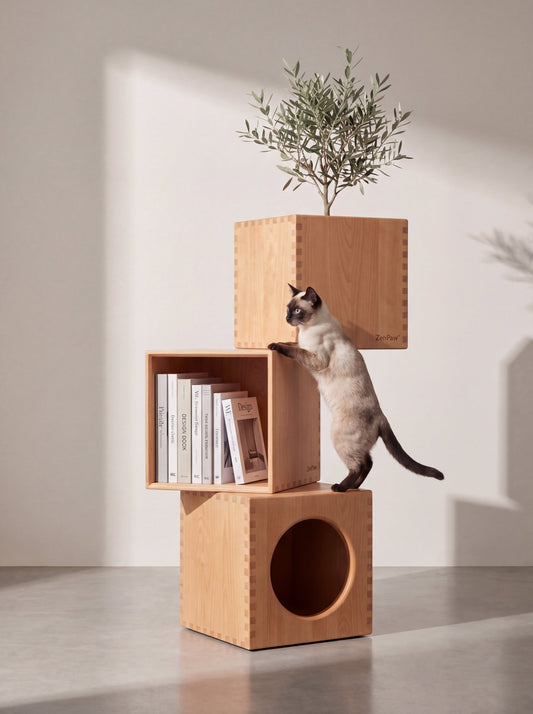
The ZenPaw Horizon Sanctuary is a handcrafted wooden cat house end table made from solid beechwood, joined entirely with traditional mortise and tenon joinery — no glue, no nails, no metal hardware.
It was designed around a single idea: that a home shared with a cat shouldn't look like it. That the furniture you choose for your pet should be as considered, as durable, and as beautiful as the furniture you choose for yourself.
What makes it different from other wooden cat house end tables:
- Solid Beechwood construction — not MDF, not particleboard, not veneer over engineered wood. The same dense, smooth-grained hardwood used in high-end European furniture for centuries.
- Mortise and tenon joinery throughout — every joint is cut and fitted by hand. No adhesives. No screws. The structure is held together by precision alone.
- Natural wood wax oil finish — plant-based, non-toxic once cured, and renewable at home with a cloth and a tin of wax.
- Natural hemp and linen cushion — removable and washable, made from natural fibers that breathe, regulate temperature, and don't off-gas.
- Fully assembled delivery — arrives ready to place, with no assembly required on your end.
The Large version measures 24"W × 24"D × 26"H (61 × 61 × 66 cm) externally, with an interior of 20"W × 21"D × 18"H — spacious enough for Maine Coons and large Ragdolls to use as a true elevated cat bed. The open front entry measures 20"W × 18"H, with ventilation slats at a 2" gap on the side panel.
The top surface functions as a fully usable end table — flat, stable, and rated to hold up to 30 lbs — making it genuinely useful as a surface for a lamp, a book, or a glass of water.
It's made to order, with a production time of 15–20 business days. Because each piece is built individually, the joinery is fitted to the specific wood — not cut by a machine to a generic tolerance.
→ View the ZenPaw Horizon Sanctuary
Frequently Asked Questions About Wooden Cat House End Tables
Is a wooden cat house end table safe for cats?
A solid wood cat house end table with a natural, non-toxic finish and no adhesives is among the safest enclosed cat furniture available. The key factors are: solid wood (not MDF or particleboard, which off-gas formaldehyde), a cured natural finish (not polyurethane or lacquer), and slat spacing of 2" or less to prevent entrapment. Avoid furniture marketed as "wood" that lists "engineered wood" or "wood composite" in the materials.
What size cat house end table do I need?
For most domestic cats, an interior of 16"×16"×14" (W×D×H) is sufficient. For large breeds — Maine Coon, Ragdoll, Norwegian Forest Cat, Siberian — look for an interior of at least 20"×20"×16". The exterior dimensions should align with standard end table heights (22"–26") to sit comfortably beside a sofa.
How is mortise and tenon joinery different from regular wood furniture?
Most wood furniture — including most "solid wood" furniture — uses screws, cam locks, or wood glue to join pieces. Mortise and tenon joinery cuts a projecting tenon on one piece and a matching cavity (mortise) on the other; the two fit together without any adhesive or hardware. The joint is stronger under repeated stress, produces no chemical off-gassing, and can be repaired or tightened without disassembling the whole piece.
Can a cat house end table hold a lamp?
Yes — provided the top surface is rated for the weight. A solid wood end table top should comfortably hold a standard table lamp (typically 5–10 lbs). The ZenPaw Horizon Sanctuary's top surface is rated to 30 lbs, making it suitable for a lamp, books, a small plant, or a glass.
What is the best wood for cat furniture?
Solid hardwoods — beechwood, oak, walnut, maple — are the best choices for cat furniture. They're dense enough to resist scratching, stable enough to hold their shape in varying humidity, and safe when finished with natural oils or waxes. Beechwood is particularly well-suited: it has a fine, even grain that takes natural finishes cleanly, and it's one of the hardest European hardwoods, making it highly resistant to the daily wear of cat use.
Is it worth paying more for handcrafted cat furniture?
For a piece of furniture you'll use daily for a decade or more, yes. Mass-produced cat furniture — even at premium price points — is typically MDF with a wood veneer, assembled with screws or cam locks that loosen over time. Handcrafted solid wood furniture with traditional joinery is built to last a generation, not a product cycle. The higher upfront cost is amortized across a much longer useful life.
Summary: What to Look for in a Wooden Cat House End Table
The best wooden cat house end table is one that functions as real furniture first — sized to your sofa, finished to match your interior, and built to last — while giving your cat a space that's genuinely comfortable and safe.
The checklist is simple:
- ✅ Solid wood (not MDF or engineered wood)
- ✅ Natural, non-toxic finish (wood wax oil, not polyurethane or lacquer)
- ✅ Traditional joinery (mortise and tenon, not screws or glue)
- ✅ Correct interior dimensions for your cat's size
- ✅ 2" slat spacing for ventilation and safety
- ✅ Natural interior lining (hemp, linen, or wool — not synthetic foam or polyester)
If you're looking for a cat house end table that checks every one of these boxes — and that's made by hand, to order, from solid beechwood — the ZenPaw Horizon Sanctuary is the place to start.
→ Shop the ZenPaw Horizon Sanctuary at zenpawnature.com
Tags:
Previous
How to Design a Pet-Friendly Living Room Without Sacrificing Style (2026 Guide)
Next
Why Elevated Pet Feeders Are Better | Solid Wood Cat Bowl Stand | ZenPaw