
How to Design a Pet-Friendly Living Room Without Sacrificing Style (2026 Guide)
Target Keywords (primary): pet friendly living room, pet friendly interior design, stylish cat furniture for living room, cat furniture that looks like real furniture, pet friendly home decor
Secondary Keywords: elevated cat bed, wooden cat house end table, solid oak cat furniture, mortise and tenon pet furniture, how to make living room pet friendly
Internal Link: → The Complete Guide to Choosing a Wooden Cat House End Table (2026)
Introduction
You've spent months getting your living room exactly right. The sofa is the perfect shade of warm linen. The side tables are solid oak. The throw pillows are from that small-batch studio you found on Instagram.
Then your cat claims the corner armchair as her personal throne — and suddenly the room feels like it belongs to her, not you.
This is the central tension of pet-friendly interior design: your home should work for both of you. Not a compromise where the pet corner looks like a PetSmart display, and not a sterile space where your cat has nowhere comfortable to exist.
The good news? A new generation of pet furniture is solving this problem — not by hiding pet products, but by making them genuinely beautiful. This guide covers 5 actionable design principles for a pet-friendly living room that doesn't sacrifice style, and introduces the one product category that's quietly changing how pet owners think about home decor.
Why Most Pet Furniture Fails the Style Test
Walk into any major pet retailer and you'll notice the same problem: pet furniture is designed for pets, not for rooms.
The typical cat tree is a beige carpet-wrapped tower that clashes with everything. The average dog crate is a wire cage you hide behind the sofa. Even the "designer" options tend to be plastic-heavy, brightly colored, or proportioned for a kennel rather than a living room.
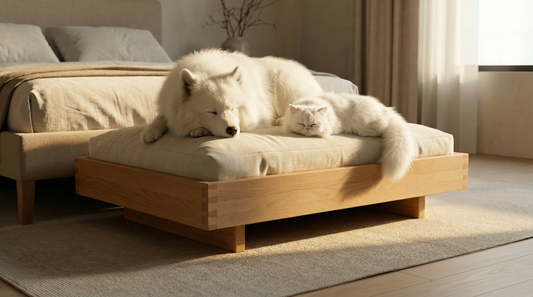
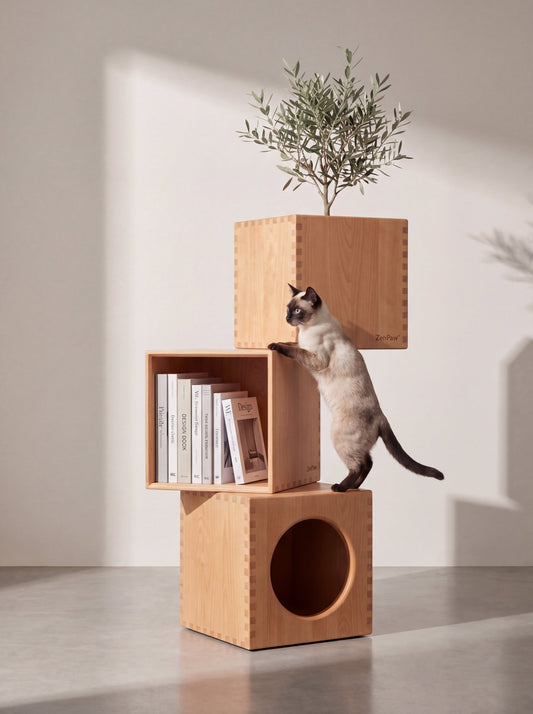
The result is a generation of pet owners making an impossible choice: buy practical pet furniture that ruins the room's aesthetic, or buy beautiful furniture that your pet ignores. What's missing is a true elevated cat bed — one that functions as real furniture and gives your cat a proper resting space at the same time.
The underlying issue is category confusion. Most pet furniture is designed by pet product companies who think about function first and aesthetics never. Meanwhile, most furniture companies don't design for pets at all.
The gap between these two worlds is where ZenPawNature was built.
5 Principles for a Stylish Pet-Friendly Living Room
1. Choose Furniture That Earns Its Place in the Room
The first principle is deceptively simple: every piece of pet furniture should be able to justify its presence without the pet in it.
If you removed your cat from the equation, would you still want that piece of furniture in your living room? If the answer is no, it's a pet product disguised as furniture — and it will always look out of place.
The practical test: hold up a photo of the piece next to your other furniture. Does it belong? Does it feel like it was designed for the same room, or like it was imported from a different aesthetic universe?
This is why solid wood construction matters beyond durability. A piece built from solid oak with a natural wood wax oil finish reads as furniture first. The grain, the weight, the proportions — these are the same visual signals your other wooden pieces send.
2. Match Scale to Your Room, Not Just to Your Pet
Most pet owners size their pet furniture by their pet — which makes sense for function but creates scale problems in the room.
A cat tower sized for a cat is typically 18–24 inches wide and 60–72 inches tall. That's a vertical column that competes with your floor lamps and bookshelves for visual dominance. In a room with 9-foot ceilings, it reads as clutter.
The better approach: size pet furniture to match your existing furniture scale.
Standard living room end tables range from 22–28 inches in height and 18–26 inches square. A pet piece that matches these proportions disappears into the room — it reads as furniture, not as an intrusion.
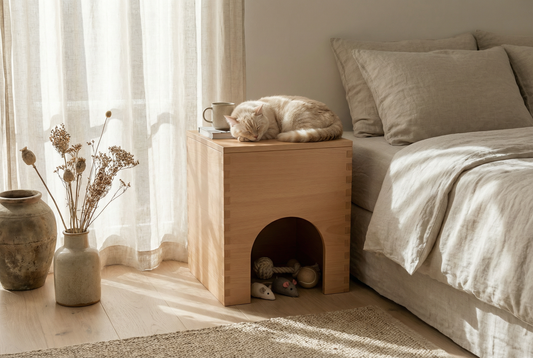
This is why the Cat House End Table category has grown significantly in the past two years. At 24"W × 24"D × 26"H, the ZenPaw Horizon Sanctuary sits at exactly the right height to flank a sofa — because it was designed to be an end table first, a cat house second.
3. Contain the Visual Chaos of Pet Accessories
Toys, leashes, extra beds, food bowls — pet ownership generates an enormous amount of small objects. In a styled living room, these objects are the enemy of visual calm.
The design solution is containment architecture: furniture that creates natural homes for pet accessories, so they're accessible but not visible.
An enclosed cat house with a solid top surface solves two problems simultaneously. The interior provides your cat with the enclosed, den-like sleeping space cats instinctively prefer. The top surface becomes functional storage or display space — a spot for a plant, a book, a candle. The accessories stay inside. The room stays calm.
4. Prioritize Materials That Age Well With Pets
Pets are hard on furniture. Claws, fur, moisture, and the occasional accident are facts of pet ownership — and they reveal the quality (or lack of it) in your furniture choices.
The materials that fail fastest in pet households are:
- MDF and particleboard: absorbs moisture, swells, and delaminates within 2–3 years of regular pet contact
- Upholstered surfaces: trap fur, absorb odors, and are nearly impossible to fully clean
- Painted finishes: chip and scratch, revealing cheap substrate underneath
The materials that hold up:
- Solid hardwood: scratches can be sanded and refinished; the structural integrity doesn't degrade with moisture
- Natural oil finishes: penetrate the wood rather than sitting on top, so they don't chip or peel — they simply need occasional reapplication
- Removable, washable linings: the interior of any pet sleeping space should have a removable pad that goes in the washing machine
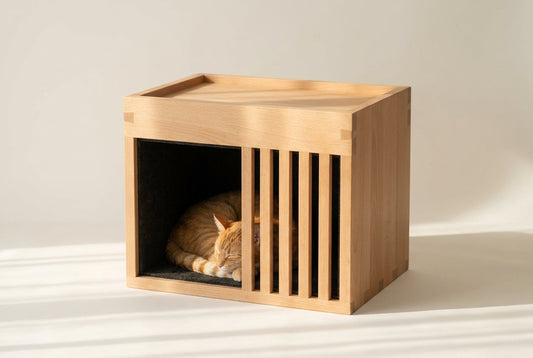
The ZenPaw Horizon Sanctuary uses solid oak construction with no glue and no nails — the pieces are held together by traditional mortise and tenon joinery. This means the structural integrity of the piece doesn't depend on adhesives that can fail with humidity changes. The removable charcoal felt pad lifts out for washing.
5. Use Negative Space as a Design Tool
The most common mistake in pet-friendly rooms is over-furnishing. When you're trying to accommodate both human and pet needs, the instinct is to add more — more storage, more beds, more scratching surfaces.
The rooms that work best do the opposite. They choose one or two well-designed multi-functional pieces and leave generous negative space around them.
A single Cat House End Table, positioned thoughtfully beside a sofa, accomplishes more than three separate pet products scattered around the room. It gives your cat a sleeping space, a perch, and a den. It gives you an end table, a side surface, and a contained pet zone. And it does all of this without visually fragmenting the room.
The Furniture Piece That Solves the Style-vs-Pet Dilemma
The Cat House End Table (also called a Pet Crate Side Table) is the product category that has most successfully bridged the gap between pet furniture and real furniture.
The concept is straightforward: an enclosed wooden cabinet, sized to function as a living room end table, with an opening on one face for the cat to enter and exit. The interior provides a den-like sleeping space — effectively an elevated cat bed built into a piece of real furniture. The top provides a flat surface at standard end table height.
When it's well-made, it's indistinguishable from furniture. When it's poorly made, it's a wooden box that happens to have a hole in it.
The difference comes down to three factors: material quality, joinery method, and proportions.
ZenPaw Horizon Sanctuary: Specifications for the Styled Pet-Friendly Room
The ZenPaw Horizon Sanctuary Large is designed to meet the exact proportional requirements of a standard living room end table while providing a full-size sleeping enclosure for cats up to 20 lbs.
Complete Specifications
| Dimension | Measurement |
|---|---|
| Overall Width | 24" (61 cm) |
| Overall Depth | 24" (61 cm) |
| Overall Height | 26" (66 cm) |
| Interior Width | 20" (51 cm) |
| Interior Depth | 21" (53 cm) |
| Interior Height | 18" (46 cm) |
| Entry Opening | 20"W × 18"H (51 × 46 cm) |
| Top Surface | 24" × 24" (61 × 61 cm) |
| Top Weight Capacity | 30 lbs (13.6 kg) |
| Fits Pets Up To | 20 lbs (9 kg) |
| Slat Spacing | 2" gap (5 cm) |
| Material | Solid Oak, No Glue, No Nails |
| Interior Lining | Removable Felt Pad (Charcoal) |
Why These Dimensions Work in a Living Room
At 26 inches tall, this piece sits at the lower end of standard end table height (22–30 inches is the accepted range for sofa-side tables). This means it can flank a standard sofa without the top surface feeling awkwardly high or low relative to the armrest.
At 24" × 24", the footprint is compact enough to fit beside most sofas without blocking traffic flow, while large enough to feel substantial and intentional — not like an afterthought.
The 18-inch interior height provides standing clearance for cats up to approximately 14 inches at the shoulder — which covers the majority of domestic cat breeds. The 20-inch entry opening is wide enough for a cat to enter and exit without squeezing, which is important for cats who may be reluctant to use enclosed spaces.
The 2-inch slat spacing on the side panel is a deliberate safety specification: wide enough for a cat to see out and extend a paw, narrow enough that no part of the cat's body can become trapped.
The Joinery Difference
Most wooden cat houses on the market are assembled with screws, staples, or wood glue. The ZenPaw Horizon Sanctuary uses traditional mortise and tenon joinery — a construction method that predates the use of metal fasteners by thousands of years.
In practical terms, this means:
- No adhesives that can off-gas VOCs in an enclosed sleeping space
- No metal fasteners that can work loose over time and create sharp edges
- Structural integrity that improves with use — mortise and tenon joints tighten as the wood expands and contracts with seasonal humidity changes
For a piece that your cat will spend 12–16 hours per day inside, the absence of glue and nails is not a marketing claim — it's a meaningful safety specification.
For a deeper comparison of wooden cat house construction methods, see our guide: The Complete Guide to Choosing a Wooden Cat House End Table (2026)
How to Style the ZenPaw Horizon Sanctuary in Your Living Room
Placement
Position the piece at the end of your sofa, aligned with the sofa arm. The 26-inch height will sit slightly below or flush with most sofa arm heights (standard sofa arm height is 25–28 inches), creating a natural visual continuation of the sofa's horizontal line.
Avoid placing it in a corner — enclosed spaces in corners can feel like hiding spots rather than resting places, and cats often prefer to observe the room from their resting space. A position with sightlines to the room's main activity area is ideal.
Top Surface Styling
The 24" × 24" top surface (with a weight capacity of 30 lbs / 13.6 kg) is functional display space. Three approaches that work well:
Minimal: A single medium-sized plant (a trailing pothos or a compact fiddle leaf) in a ceramic pot. The organic form contrasts with the clean geometry of the wood.
Functional: A small tray holding a candle, a coaster, and a book. This creates a "curated" look that signals the piece is furniture, not pet equipment.
Seasonal: Rotate objects by season — a small vase of dried botanicals in autumn, a simple stone or crystal object in winter. This keeps the piece feeling intentional rather than static.
Material Pairing
Solid oak reads as warm and natural. It pairs best with:
- Linen and cotton upholstery in warm neutrals (ivory, warm white, oatmeal, camel)
- Other natural materials: rattan, jute, ceramic, stone
- Warm metals: brushed brass, aged copper (for hardware elsewhere in the room)
It contrasts well with:
- Dark painted walls (forest green, charcoal, navy) — the light oak grain becomes a focal point
- Dark upholstery (charcoal velvet, dark leather) — creates high-contrast grounding
Frequently Asked Questions
Q: Will my cat actually use an enclosed cat house, or prefer open beds?
Most cats prefer enclosed spaces for sleeping — this is an instinctive behavior related to feeling protected while vulnerable. The key factors are: the opening should face the room (not a wall), the interior should be large enough to turn around in (the 20" × 21" interior of the Large version accommodates this for cats up to ~12 lbs comfortably, and up to 20 lbs for cats who prefer to curl), and the space should smell familiar before the cat is expected to use it. Placing a worn t-shirt or existing blanket inside for the first week significantly accelerates adoption.
Q: Is solid oak safe for cats who chew or scratch wood?
Solid oak is a pet-safe hardwood. The natural wood wax oil finish used on the ZenPaw Horizon Sanctuary does not contain formaldehyde, lead, or synthetic VOCs. Cats who scratch the exterior are unlikely to ingest meaningful quantities of wood or finish. If your cat is a persistent chewer of furniture, consult your veterinarian — this behavior can indicate dietary deficiencies or anxiety.
Q: How do I clean the interior?
The removable charcoal felt pad lifts out and can be hand-washed or machine-washed on a gentle cycle. The interior wood surfaces can be wiped with a damp cloth. Avoid saturating the wood with liquid. For odor control between washes, a light sprinkle of baking soda on the pad, left for 30 minutes before shaking out, is effective.
Q: Will the slat spacing trap my cat's paw?
The 2-inch (5 cm) slat spacing is sized to allow a cat to extend a paw through the slats without the paw becoming trapped. Cat paws range from approximately 1.5 to 2.5 inches in width; the 2-inch gap is the standard safety specification used by reputable pet furniture manufacturers. A cat's head cannot fit through a 2-inch gap.
Q: Can I use this as an end table without a cat?
Yes. The piece functions as a standard end table with enclosed cabinet storage. The entry opening can face a wall to minimize the visual "this is a pet product" signal if you prefer a more neutral look. The top surface supports up to 30 lbs, suitable for lamps, plants, books, or decorative objects.
Q: What's the difference between MDF and solid oak for this type of furniture?
MDF (medium-density fiberboard) is an engineered wood product made from wood fibers bonded with adhesive under heat and pressure. It's uniform, inexpensive, and easy to machine — which is why most mass-market pet furniture uses it. However, MDF is not waterproof, swells when exposed to moisture, and the adhesive binders can off-gas formaldehyde, particularly in enclosed spaces. Solid oak is a natural hardwood that can be refinished, repaired, and will last for decades with basic maintenance. For a piece your cat will sleep inside for 12+ hours a day, the material difference is meaningful.
The Bottom Line
A pet-friendly living room doesn't require a compromise between your home's aesthetic and your pet's comfort. It requires choosing furniture that was designed to serve both purposes — not pet products dressed up as furniture, and not furniture your pet has to compete with.
The five principles in this guide — earning its place, matching scale, containing chaos, prioritizing durable materials, and using negative space — apply to any pet-friendly design decision. But the easiest single step you can take is replacing your cat's separate bed, crate, or tower with one well-made piece that functions as both furniture and elevated cat bed.
The ZenPaw Horizon Sanctuary Large (24"W × 24"D × 26"H, Solid Oak, No Glue, No Nails) is designed for exactly this purpose.
→ Shop the ZenPaw Horizon Sanctuary
→ Read our complete guide to choosing a wooden cat house end table
References
- American Kennel Club — Cat Furniture Safety Guidelines
- ASPCA — Pet-Safe Wood Finishes and Materials
- Architectural Digest — How to Design a Pet-Friendly Home
- Google Trends — Pet Bed Category Search Volume, May 2026
- Chewy — Cat House & Crate Size Guide
- The Spruce Pets — Best Cat Furniture for Small Apartments
Tags: