
Mortise and Tenon Cat House Side Table | Japandi Pet Furniture | ZenPaw Horizon
The 600-Year-Old Technique Behind Your Cat's Side Table
Before screws existed
The Forbidden City in Beijing has stood for over 600 years. So have countless temples across Japan, China, and Korea — timber-frame structures that have survived earthquakes, fires (when rebuilt), and six centuries of weather. None of them were held together with screws. Screws hadn't been invented yet for construction use, and the craftsmen who built these structures didn't need them.
What they used was mortise and tenon joinery: a protruding tongue of wood (the tenon) cut to fit precisely into a corresponding slot (the mortise) in the receiving piece. When the fit is tight enough, the joint holds under load without any fastener. Under stress, it actually tightens — the wood compresses slightly and grips harder. The more you use it, the stronger it gets.
Why this matters for a cat house
Most cat furniture is held together with metal screws driven into composite wood. Over time, the screw holes widen, the wood around them compresses, and the piece begins to wobble. Cats are not gentle with their furniture — they jump on it, push against it, treat it as a launching pad. A piece held by screws degrades under this use. A piece held by mortise and tenon joinery tightens under it.
There's also the material question. Screws require pilot holes, which means the wood around them is structurally compromised. Mortise and tenon joints distribute load across the full contact area of the joint — the wood isn't pierced, it's shaped. The structural integrity of a mortise and tenon piece comes from geometry, not from metal.
The Horizon: what the joinery makes possible
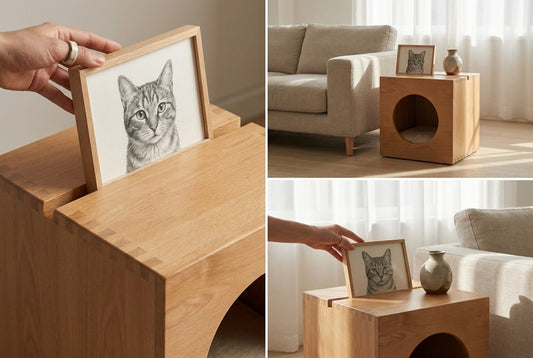
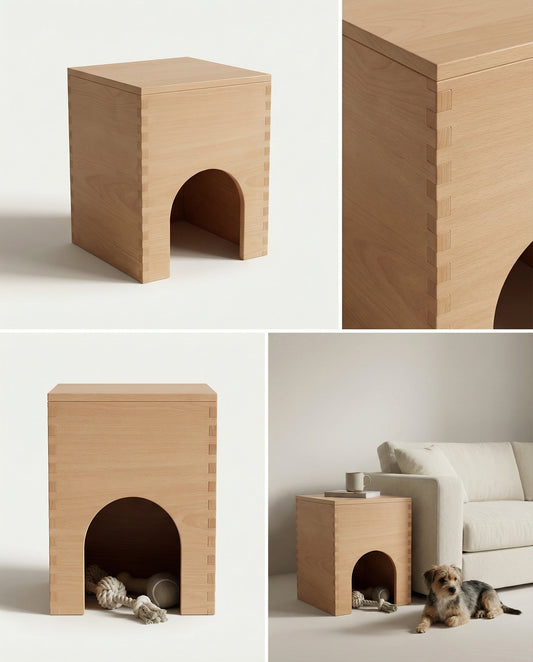
The ZenPaw Horizon is a solid beechwood side table and cat sanctuary built with hand-cut mortise and tenon joinery throughout. The top surface — 24" × 24", solid beechwood — supports a lamp, books, and a glass without flex. The structure below provides a dark, ventilated retreat for your cat, with slatted sides that give them visibility into the room.
The slatted design is specifically considered: 2-inch spacing allows airflow and partial visibility without creating gaps that a head could get stuck in. Cats prefer spaces where they can observe without being fully observed — the Horizon's side slats deliver exactly this balance. Designed to U.S. pet safety standards.
Beechwood: why this hardwood specifically
Beechwood is chosen for the Horizon because of its combination of properties that matter for pet furniture: a tight, uniform grain that makes precise joinery cuts possible; exceptional hardness (1,300 on the Janka scale, significantly harder than pine or cherry); a pale, warm tone that works with virtually any interior palette; and a natural resistance to splitting under load.
All ZenPaw beechwood is FSC-certified — sourced from forests managed to maintain biodiversity and prevent deforestation. Each piece planted through the ZenPaw tree program offsets the wood used in production.
It arrives assembled. Because it has to.
Mortise and tenon joinery can't be flat-packed. The joints are cut to fit each other specifically — a tenon cut for one mortise won't fit another. The Horizon arrives fully assembled, which means it also arrives as a single coherent object, not a kit. Place it. That's it.
→ Shop the Horizon
Tags: